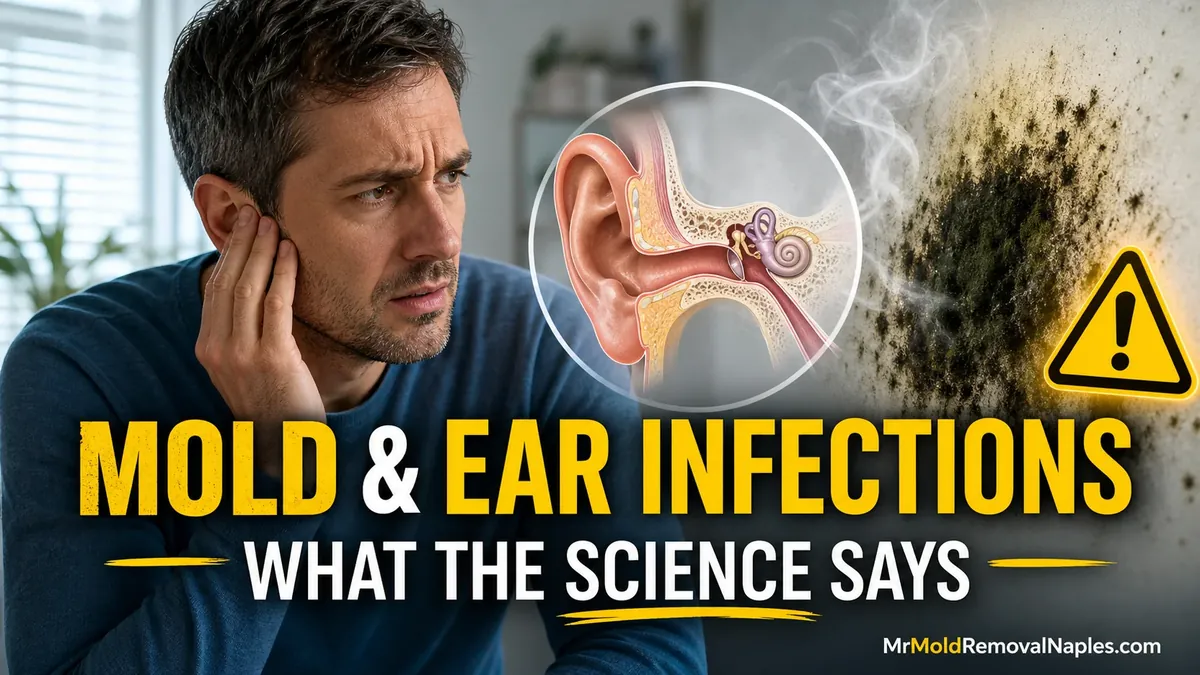
Can Mold Cause Ear Infections? Yes - But Usually Not the Way You Think
It's 2 a.m., and your four-year-old is crying with ear pain again. This is the third infection this year. The antibiotics worked before - but why do they keep coming back? Then your pediatrician asks a question no one expected: "Have you noticed any mold in your home?"
Yes, mold can cause ear infections - but in most cases it's indirect. Mold allergy creates nasal congestion and fluid buildup where bacteria can grow. Less often, mold spores enter the ear canal directly and cause a fungal ear infection called otomycosis. Understanding which type you're dealing with changes everything about treatment.
If you're in Naples or anywhere in Collier County, this is especially relevant. Our humid subtropical climate, with average indoor relative humidity hovering around 78%, creates near-perfect conditions for mold growth year-round - and hurricane season (June through November) only makes it worse.
| Ear Issue | Direct or Indirect? | How Mold Fits In | Typical Symptoms | First-Line Treatment |
|---|---|---|---|---|
| Allergy-driven Eustachian tube dysfunction | Indirect | Mold allergy triggers nasal congestion, tube can't drain | Ear fullness, popping, pressure, recurrent infections | Nasal steroid spray, antihistamine, fix moisture source |
| Fungal otitis externa (otomycosis) | Direct | Mold spores enter and grow in ear canal | Itching, pain, discharge, muffled hearing | Professional cleaning + antifungal ear drops; keep ear dry |
| Secondary bacterial otitis media | Indirect | Fluid trapped behind eardrum becomes infected | Ear pain, fever, hearing loss | Antibiotics if bacterial; treat underlying allergy/exposure |
Yes, Mold Can Be a Hidden Trigger for Ear Infections - Here's How
Mold doesn't usually walk into your ear and start an infection. The process is more subtle - and more insidious.
Here's the chain reaction: Mold spores become airborne. You breathe them in. If you're sensitive, your immune system overreacts, causing your nasal passages to swell. That swelling blocks the Eustachian tube. Fluid builds up in the middle ear. Bacteria move in. You have an ear infection.
That's the indirect route - and it's the most common. Now the direct route:
- Mold spores land in a warm, moist ear canal
- They colonize - especially if the canal is already irritated
- The result is otomycosis, a fungal outer ear infection
- This is more common in people who use cotton swabs, wear hearing aids, or have skin conditions
Naples homeowners face both risks. Water intrusion after storms, condensation on AC ducts, and damp bathrooms are all common sources. If you've noticed a musty smell or visible growth, a professional mold inspection can confirm what you're dealing with.
Direct Infection vs. Allergy-Driven Infection: What's Actually Happening?
This distinction matters more than you might think - because the treatments are completely different.
Direct fungal infection (otomycosis): The fungus is inside your ear canal. Antibiotics won't touch it. You need antifungal ear drops, professional cleaning, and a dry ear environment. Giving antibiotics here makes things worse by disrupting the bacterial balance that normally keeps fungal growth in check.
Indirect allergy-driven infection: The problem is in your middle ear, caused by trapped fluid and bacteria. Here, the Eustachian tube is the culprit. Antifungal drops won't fix it. You need to treat the allergy trigger - including the mold in your environment - alongside any antibiotics your doctor prescribes.
Why do most people miss this? Because symptoms overlap. Ear pain, muffled hearing, and pressure occur in both. Only a doctor with an otoscope can tell the difference - and even then, a culture may be needed.
How to Tell If Mold Is a Suspected Cause
This is not a self-diagnosis tool. Use this checklist to start an honest conversation with your doctor or ENT.
Symptom patterns that point toward mold as a trigger:
- Ear infections that clear up with antibiotics - then come right back
- Ear pressure or fullness that changes with seasons or weather
- Symptoms that are worse at home and better outside or on vacation
- Itchy ear canal (not just deep pain) alongside nasal congestion
- Stuffy nose, sneezing, and post-nasal drip at the same time as ear symptoms
- Visible water stains, dampness, or a musty smell somewhere in your home
- Symptoms that worsened after a flood, roof leak, or plumbing issue
In Collier County, symptoms often flare during hurricane season and again when snowbirds return and homes re-open after sitting closed all summer. An empty house with AC off is a mold incubator.
If three or more of these apply, bring the list to your doctor. Ask specifically about mold allergy testing. Don't wait.
What Doctors Look For: From Otoscopy to Allergy Testing
A good diagnostic workup doesn't start with a mold test. It starts with your ear.
Here's what a realistic evaluation looks like:
- Otoscopy: The doctor looks in the ear canal. They check for fluid behind the eardrum, a retracted eardrum, or fungal debris.
- Pneumatic otoscopy / tympanometry: These tests measure how well the middle ear is draining and whether there's pressure buildup.
- Fungal culture: If there's discharge or debris in the canal, a swab can distinguish fungal from bacterial infection.
- Allergy bloodwork: If no clear infection source is found, a blood test for mold-specific IgE antibodies can reveal whether your immune system is reacting to mold.
- ENT referral: If ear infections are recurring or fluid persists for months, ask for a specialist. An ENT has tools and training that go beyond a primary care visit.
Don't skip steps. Testing your home for mold before you understand the ear problem is putting the cart before the horse. Get the medical picture first.
Treatment: Ear Drops, Steroids, and Cutting Off the Source
Treating the ear alone won't work if mold exposure continues. This is the mistake most people make - they finish the antibiotic course and return to the same damp bedroom.
Here's how treatment should be layered:
- Fungal ear infection: Professional ear cleaning by a doctor, followed by antifungal ear drops. Keep the ear dry during treatment.
- Bacterial ear infection (otitis media): Antibiotics as prescribed. But if infections keep recurring, the antibiotic isn't solving the root cause.
- Allergy-driven Eustachian tube dysfunction: Nasal corticosteroid sprays, oral antihistamines, and decongestants. These reduce the swelling that blocks drainage.
- Environmental control: Fix the moisture. Remove the mold. This step is not optional if you want lasting results.
If symptoms are mild and there's no active infection, watchful waiting - combined with moisture control - may be the right first move. You don't always need medication immediately. Sometimes drying out the house is the most powerful prescription.
For homes with significant mold growth, professional mold remediation may be necessary. The cost for most residential projects runs $1,500–$5,000 depending on the extent of the problem - far less than years of recurring medical bills and missed work.
The Child-Specific Section: Recurrent Ear Infections and Mold Exposure
If your child keeps getting ear infections, mold isn't a scary "toxin" - it's a common allergen that makes a structural problem worse.
Here's the anatomy issue: young children have shorter, more horizontal Eustachian tubes. They drain poorly by design. Any swelling from an allergen like mold makes drainage even harder. The result is chronic fluid and repeated infections.
What parents should do:
- Fix visible dampness in your home first - especially in bedrooms and bathrooms
- Ask your pediatrician whether allergy testing is appropriate
- Don't default to antibiotics without asking whether allergy management has been tried
- Ask about ear tubes (myringotomy) if fluid has lasted 3 or more months, or if infections keep recurring despite treatment - this is a conversation for an ENT, not a fix-it yourself decision
Mold spreads within 72 hours after a water event. A leak that soaks your child's bedroom wall on Sunday can be an active mold problem by Wednesday. Speed matters in Naples, where humidity never truly lets up.
When to Test Your Home for Mold - and When Not To
Don't start by testing the air. Start by looking for moisture.
If you can see mold or smell a persistent musty odor, you already have your answer. Air testing adds cost - not clarity. The EPA and CDC generally recommend controlling moisture rather than routine air testing, because mold levels vary hour to hour and test results are hard to interpret without a baseline.
When mold testing does make sense:
- A doctor needs confirmation of mold exposure to guide allergy treatment
- You've fixed visible mold but symptoms persist
- You suspect hidden mold behind walls after a flood or roof leak
- You're buying or selling a home and want documentation
If you hire anyone, hire a certified independent mold inspector - not a remediation company offering free inspections. The conflict of interest is real. A proper mold inspection in Naples costs roughly $300–$1,000 (average around $600), with lab testing adding $75–$100 per sample.
Avoid spending on testing if it delays fixing the actual moisture problem. The mold doesn't care what the test says.
How to Prevent Mold-Related Ear Infections
Prevention works on two fronts: the home and the ear itself.
For the home:
- Fix leaks and dry wet materials within 24–48 hours
- Keep indoor humidity between 30–50% - use a hygrometer, not guesswork
- Run exhaust fans in bathrooms and the kitchen during and after use
- Check HVAC drip pans and air handler units regularly - mold in HVAC ducts spreads spores through every room
- Inspect attic spaces after any roof event - attic mold is one of the most common hidden sources in Naples homes
For your ears:
- Keep ears dry after swimming or showering - tilt your head, use a towel, avoid cotton swabs
- Treat seasonal allergies early - don't wait for an ear infection to develop
- Don't skip follow-up appointments after an ear infection clears
During snowbird season, when Naples homes go from fully occupied to vacant and back again, HVAC systems often restart after months of dormancy. That's a prime time for mold to spread through ducts. Run a system check before closing up for summer.
It Depends: Does Everyone React to Mold the Same Way?
No - and this is the honest answer most mold remediation companies won't give you.
Mold is everywhere. Spores are present indoors and outdoors constantly. Whether mold causes you ear problems depends on your immune system, your genetics, and your baseline health.
- Someone with seasonal allergies or asthma is far more likely to develop Eustachian tube dysfunction from mold exposure
- Someone with no allergies may live in a moldy home for months with no ear symptoms at all
- Direct fungal ear infections (otomycosis) are more common in people with diabetes, skin conditions, or suppressed immunity
- Children are more vulnerable due to their anatomy - not because mold is more "toxic" to them
For most people, the answer is: mold can be one cause among several. For some - especially those with persistent, unexplained recurrence - it may be the reason nothing has worked so far.
If you're in that second group and you've exhausted other explanations, it's time to take the home environment seriously.
Emergency mold removal is available when the situation is urgent, and standard mold remediation follows a defined IICRC S520 process: containment, negative air pressure, HEPA scrubbers (rated at 99.97% efficiency at 0.3 microns), antimicrobial treatment, and clearance testing.
Final Verdict
Here's what the evidence actually supports:
- Yes, mold can cause ear infections - usually indirectly through allergy and Eustachian tube dysfunction
- Direct fungal ear infections from mold are real - but less common, and require different treatment than bacterial infections
- Start with medical evaluation, not home mold testing - understand the ear first
- Fix moisture regardless - even if a doctor can't prove mold is the cause, a damp home is a health liability in Naples year-round
- Recurring ear infections in a damp home are not a coincidence - investigate both fronts
The honest answer: mold usually makes the conditions right for an ear infection rather than causing one directly. Fixing the air you breathe matters as much as fixing the ear. If you suspect mold is part of the problem, don't wait for a second opinion. Check your home and talk to your doctor in the same week.
Want to understand what remediation would actually cost for your situation? See our mold remediation cost guide for Naples, FL for a realistic breakdown.
Frequently Asked Questions
Yes - mostly indirectly. Mold allergy causes nasal congestion and swelling that blocks the Eustachian tube, allowing fluid to build up in the middle ear. Bacteria grow in that fluid and cause an infection. Less commonly, mold spores can enter the ear canal directly and cause a fungal ear infection called otomycosis.
Signs that overlap with mold allergy include persistent cough, nasal congestion, recurring headaches, fatigue, sore throat, ear pressure or pain, dizziness, and itchy eyes. These are allergy and irritation symptoms - not signs of poisoning. If they consistently improve when you leave home and return when you come back, environmental mold is worth investigating.
There is no special "black mold" ear infection. Any mold species can act as an allergen trigger. Not every dark mold is Stachybotrys, and official agencies recommend removing all mold regardless of color or type. A doctor treats your symptoms - not the color of the mold. If you have black or dark growth in your home, have it assessed by a certified inspector rather than assuming the worst.
In otherwise healthy people: fungal outer ear infections (otomycosis), fungal sinusitis, and allergic reactions. In people with weakened immune systems - such as those undergoing chemotherapy, living with HIV, or taking immunosuppressant medications - mold can cause more serious respiratory and systemic infections. For the general population, the main concern is allergy-driven inflammation, not invasive infection.
Look for a pattern rather than a single episode. Mold is a likely contributor if infections recur after antibiotic treatment, if you have itchiness rather than just pain, if you also have nasal congestion and post-nasal drip, and if symptoms are consistently worse at home. Ask your doctor about mold-specific IgE allergy testing. That bloodwork can confirm whether your immune system is reacting to mold.
Mold allergy can cause Eustachian tube dysfunction, which leads to pressure, popping, muffled hearing, and in some cases tinnitus (ringing). These symptoms usually resolve when the underlying congestion and fluid are treated.
No. See the doctor first. Understand what type of ear issue you have and whether allergy is involved. Then sweep your home for visible moisture, water stains, or musty odors. Professional mold testing is not the starting point - it's a tool for specific situations, such as suspected hidden mold or confirming exposure for medical records. Controlling moisture is always step one, whether or not you ever run a test.