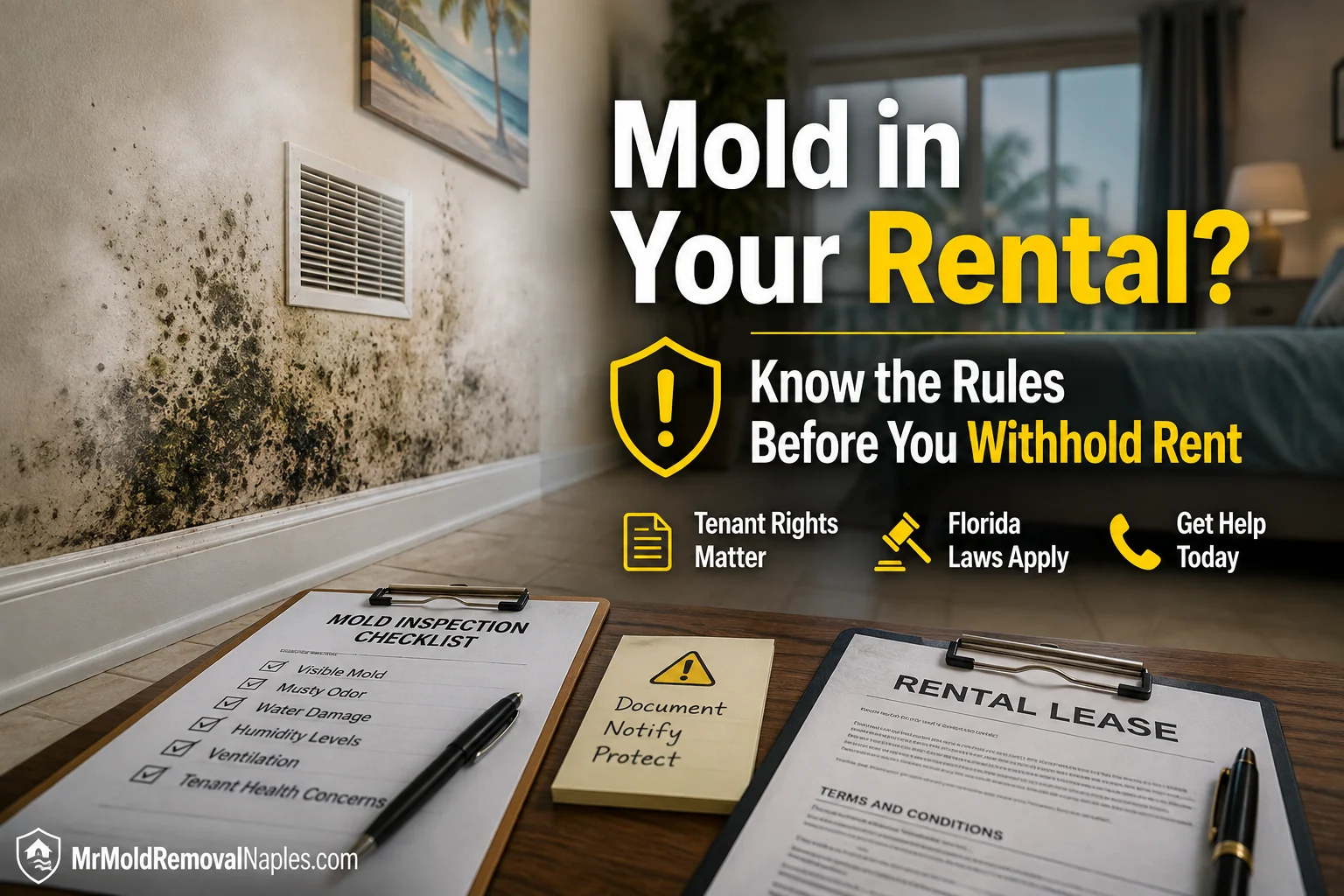
Can I Withhold Rent for Mold in Florida? The Legal Answer
You found black spots spreading up the bedroom wall of your Naples rental, sent your landlord two emails, and nothing happened. Now you are wondering if you can just stop paying rent until the mold is gone. It feels fair, but Florida law does not work on feelings.
The short answer: you can only withhold rent for mold in narrow situations, and never without written notice, proof, and usually a lawyer. Florida does not have a simple rule that says mold lets you stop paying rent. Tenants who withhold rent on their own guess often end up in eviction court, where a judge decides whether the rent was actually owed.
Honest answer: Withholding rent is a serious legal move, not a first step. Give written notice, give your landlord a reasonable chance to fix the problem, and document everything before you hold back a single dollar. In mold disputes, the side with the paper trail wins. This page is general information, not legal advice, and a Florida attorney is the right person to guide you.
What Florida Law Actually Says About Mold and Rent
Florida landlord-tenant law requires landlords to keep rental units habitable. That is the part tenants remember. The part they forget is that the law also protects landlords from tenants who stop paying rent without following the process.
There is no Florida statute that says mold automatically suspends your rent. Instead, the law looks at the facts: how serious the mold is, whether the landlord knew about it, whether you gave written notice, and whether the landlord had a reasonable chance to respond. A judge weighs those facts, not your frustration. Until a judge rules, the rent is still owed on paper, and the landlord can file for eviction the day it goes unpaid.
That is why the smart play is never to treat rent withholding as leverage. The smart play is to build a case first. A documented mold problem gives you options a guessed withholding never will.
| Step | What it does for you | Why it matters |
|---|---|---|
| Written notice | Creates a dated record the landlord cannot deny | Judges and mediators start with the notice |
| Reasonable wait time | Shows you gave the landlord a chance to act | Withholding too fast looks like bad faith |
| Photos and messages | Documents the mold and the timeline | Proof beats memory in every dispute |
| Professional inspection | Adds an objective written report with lab results | An expert report carries real weight in court |
| Legal advice | Tells you whether withholding is safe in your case | Mold law is fact-specific and changes |
The Steps Naples Tenants Should Take First
Before you even think about holding back rent, work the process in order. Each step protects you if the dispute ends up in court.
- Send written notice. Email and text are fine and timestamped. Follow up with certified mail for a serious problem so you have proof the landlord received it.
- Give the landlord a reasonable window to respond. What counts as reasonable depends on how bad the mold is and whether the landlord has been responsive. A few days is rarely enough for a real repair.
- Document everything. Date-stamped photos of the mold and any water source, a log of every call and message, and copies of everything you send. Back it up off your phone.
- Get a professional inspection. A licensed inspector documents the scope with moisture readings and lab samples. In Naples, an inspection runs $300 to $1,000 with an average near $600, and lab testing runs $75 to $100 per sample at a third-party accredited lab. That report is the single strongest piece of evidence you can own.
- Talk to a Florida attorney before withholding. An hour of legal advice is far cheaper than an eviction on your record.
If the landlord still will not act after written notice and a reasonable window, a professional mold inspection gives you the objective report you need. From there, your attorney can tell you whether withholding, breaking the lease, or another option fits your situation. The inspection report is the difference between your word and proof.
Why Naples Rentals Make This More Common
Mold moves faster in Naples than almost anywhere else a renter might live. Average humidity runs around 78 percent and peaks near 97 percent according to the National Weather Service, so a wall that gets wet stays wet. Add hurricane season from June to November and the pattern of homes sitting closed through the hot months, and small moisture problems become mold problems quickly.
Mold can spread within 72 hours of moisture intrusion. A slow leak behind a baseboard can produce visible growth before a monthly inspection would ever catch it. That speed is why fast written notice matters: the earlier the landlord is on record knowing about the problem, the harder it is to claim surprise later.
What a Mold Inspection Report Adds to Your Case
Photos show a judge that mold exists. A professional report shows a judge how bad it is, where it came from, and what it will take to fix it. Those are different arguments.
An IICRC-trained inspector follows recognized standards for finding moisture and sampling mold. Results come back from an independent accredited lab, not from whoever wants the remediation job, which keeps the findings credible. If the report shows the landlord's maintenance failure caused the problem, you have something concrete to hand to your attorney.
Remediation itself should follow the IICRC S520 standard, with containment barriers, negative air pressure, and HEPA scrubbers rated at 99.97 percent efficiency at 0.3 microns. A remediation crew that works to that standard also leaves you with a defensible record that the problem was actually solved. That matters if you stay in the unit and the mold comes back.
Withhold Rent, Break the Lease, or Repair and Deduct?
Withholding is not the only option, and it is rarely the first one a Florida attorney would choose. Know the difference:
- Withholding rent. You stop paying until the landlord fixes the problem. Highest risk: the landlord can file for eviction the day rent goes unpaid, and you have to win in court.
- Repair and deduct. Some tenants pay for a needed repair themselves and deduct it from rent. In Florida this path is narrow and usually requires the problem to threaten health or safety, proper notice, and a landlord who failed to act. It does not apply to every mold situation, and it is easy to do wrong.
- Breaking the lease. Leaving over mold is a big step with real financial risk if a court decides the unit was habitable. Florida lease-break rules are specific, and mold does not automatically excuse a lease.
Each of these carries consequences a judge could assign to you. That is why the same advice keeps coming back: document first, then get legal advice, then act. For the full landlord and tenant picture, see our guide to mold in Florida rental properties.
What Remediation Should Look Like If the Landlord Acts
If your landlord does respond and hires a crew, the work should follow a standard order: fix the moisture source, contain the area, remove moldy porous materials, clean and treat what remains, dry everything, and confirm the fix with clearance testing. A crew that just paints over the stain has not solved the problem, and you will be back here in a few months.
If the mold is limited to a small bathroom or a single wall, remediation typically runs $800 to $1,500 in the Naples market. A larger job tied to a roof leak or a whole wall cavity runs $1,500 to $2,500 or more. Those numbers matter because they show whether the landlord's excuse about cost holds up. Most residential mold projects in Naples run $1,500 to $5,000, which is a repair a landlord can budget for, not a reason to leave a unit rotting. For the full picture, see our Naples mold remediation cost guide.
The Bottom Line on Withholding Rent for Mold
Can you withhold rent for mold in Florida? Only with written notice, proof, a reasonable chance for the landlord to respond, and usually a lawyer standing behind you. Stop paying rent on a guess and you trade a mold problem for an eviction problem.
Build the case instead. Document the mold, get an inspection with lab results, and let a Florida attorney tell you which legal option fits your facts. If you need the objective report that makes your case credible, a mold removal and remediation team in Naples can document the problem and fix it the right way.
Frequently Asked Questions
Only in narrow situations, and never without a paper trail. Florida law expects a tenant who withholds rent to have given written notice, given the landlord a reasonable chance to fix the problem, and kept proof of the mold and the request. A tenant who withholds rent on their own guess usually ends up in eviction court, where a judge decides whether the rent was owed.
Florida law requires landlords to keep rental units habitable, and serious mold tied to a leak or moisture problem can make a unit uninhabitable. Whether mold rises to that level depends on how bad it is, whether the landlord knew about it, and how long it was ignored. A judge, not a tenant, makes that call, which is why documentation and legal advice matter.
Send written notice first, then give the landlord a reasonable window to respond, then document everything. Photos with dates, emails and texts, and a professional inspection report with lab results are the evidence that protects you. In Naples, a licensed inspection runs about $300 to $1,000 with an average near $600, and lab testing runs $75 to $100 per sample at a third-party accredited lab.
Yes, a landlord can file for eviction when rent is not paid, even when the tenant believes the reason is valid. The tenant then has to defend the eviction in court and prove the mold was serious, the landlord was notified, and the landlord failed to act. That is why rent withholding without legal advice is risky, even when the mold is real.
Landlords are generally responsible for structural moisture problems like roof leaks, plumbing failures, and foundation water intrusion. Tenants are responsible for reporting problems promptly, keeping the unit clean, and running bathroom exhaust fans. In humid Naples, where average humidity runs around 78 percent, a small leak can grow visible mold within days, so fast reporting protects both sides.
Standard renters policies rarely cover mold damage to belongings. Most mold damage comes from long-term moisture, which policies treat as a maintenance problem rather than a sudden covered event. A few policies add a small mold rider, but the limits are usually low. Read your policy and ask your agent before you assume anything is covered.