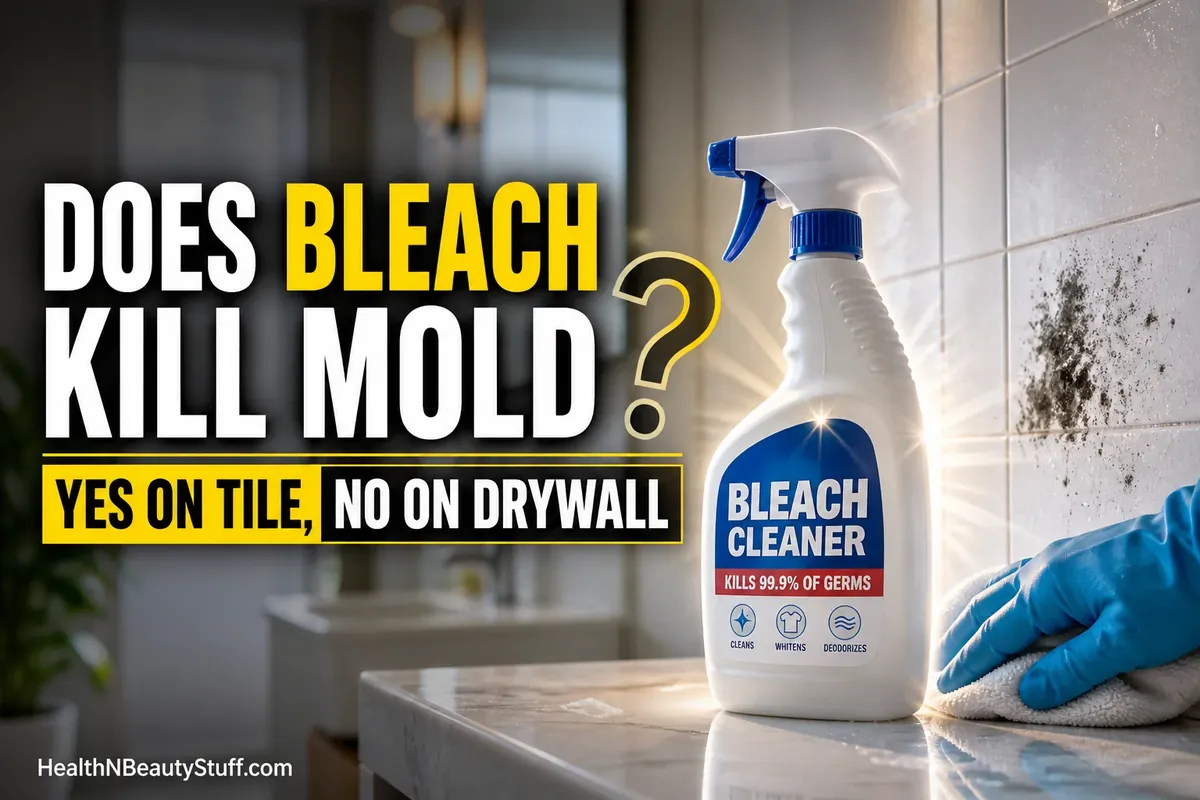
Does Bleach Kill Mold? The Honest Answer for Naples Homeowners
You spot a dark patch in the bathroom corner. You grab the bleach from under the sink. Before you pour it on, here is what Naples homeowners need to know.
Does bleach kill mold? Sometimes. Collier County’s humid climate changes how you should handle it. Naples has about 78% average relative humidity, so damp materials need fast attention.
Quick Verdict: Yes on tile, but no on drywall. Bleach kills surface mold on non-porous materials. It can leave mold alive inside porous materials and add more water.
| Surface | Does bleach work? | What to use instead |
|---|---|---|
| Tile, glass, or metal | Yes, on surface mold | Soap or detergent with water also works for routine cleanup |
| Drywall | No | Remove the mold-damaged section |
| Wood framing | No | Have the damp wood checked and treated through proper cleanup |
| Carpet | No | Remove mold-damaged carpet |
| Grout | Partial surface result | Clean with soap or detergent and water, then dry fully |
The Short Answer: Yes on Tile, No on Drywall
Bleach can kill surface mold on tile, glass, metal, and sealed surfaces. These materials do not let much liquid soak in. You can reach the visible growth and clean the surface.
Drywall, wood, insulation, and carpet are different. These materials hold water. Mold roots can grow inside them, beyond the bleach’s reach.
That makes the bleach vs mold answer simple. Use bleach only on suitable hard surfaces. Do not rely on it for porous materials.
Why Bleach Fails on Porous Surfaces
Household bleach contains water. On drywall or wood, that water can soak below the surface. It may give deeper mold the moisture it needs.
Bleach can also remove the dark color. The wall may look clean while mold survives below the surface. This creates a masking effect, not a full fix.
Mold roots grow inside porous materials. A surface wipe cannot reach those roots. If Naples humidity remains high, the patch may return.
Mold can spread within 72 hours. Find and fix the water source first. Otherwise, even the best mold killer cannot stop new growth.
What the EPA and CDC Actually Say About Bleach and Mold
The EPA does not recommend bleach for routine mold cleanup. For most household mold, it recommends soap or detergent with water.
The CDC allows bleach in disaster and flood cleanup. That matters after tropical storms and hurricanes. Naples hurricane season runs from June through November.
For those situations, the CDC dilution is 1 cup of bleach per 1 gallon of water. The area must have good airflow. Wear an N95, goggles, and gloves.
These are strict safety steps. They do not make bleach suitable for drywall, carpet, or insulation.
How to Use Bleach Safely on Non-Porous Surfaces
Use bleach only when the material is non-porous. Good examples include tile, glass, metal, and sealed surfaces.
- Put on an N95, protective goggles, and gloves.
- Open doors and windows for airflow.
- Use the CDC flood-cleanup mix of 1 cup per gallon when that guidance applies.
- Scrub the hard surface carefully.
- Remove remaining moisture and dry the area fully.
- Fix the leak or humidity problem.
Never mix bleach with ammonia. Do not combine bleach with other cleaners. Use one cleaning product at a time.
If the growth returns, stop repeating the same treatment. A mold inspection can help find hidden moisture or growth.
What to Use Instead of Bleach for Mold
For routine household cleanup, the EPA recommends soap or detergent with water. This is the clearest verified choice for washable hard surfaces.
Borax and hydrogen peroxide often appear in online tips. However, the EPA guidance provided here points to detergent and water. Product labels and surface limits still matter.
| Product | Works on | Specific note |
|---|---|---|
| Soap or detergent with water | Washable hard household surfaces | EPA choice for routine cleanup |
| Bleach solution | Tile, glass, metal, and sealed surfaces | Kills surface mold; CDC allows disaster use with strict dilution |
| Borax | Only surfaces allowed by its product label | Not the EPA’s stated routine recommendation in the verified guidance |
| Hydrogen peroxide | Only surfaces allowed by its product label | Not the EPA’s stated routine recommendation in the verified guidance |
| Material removal | Damaged drywall, insulation, and carpet | Removes porous material that surface cleaners cannot reach |
When to Call a Professional in Naples
Call a pro when mold is inside drywall, wood, carpet, or insulation. You should also get help for hidden growth, recurring patches, or storm damage.
Post-flood mold needs special care. Water may sit behind walls or beneath floors. Emergency mold removal can address wet areas before the problem spreads.
Proper professional mold removal may include containment and negative air pressure. IICRC S520 methods also use HEPA scrubbers that capture 99.97% at 0.3 microns.
For dark growth in porous materials, review Naples black mold removal options. Color alone does not show how deep the growth runs.
What Professional Mold Remediation Costs
Most residential projects cost $1,500 to $5,000. The final range reflects the location and amount of material involved.
| Project | Verified Naples cost range |
|---|---|
| Small bathroom | $800 to $1,500 |
| Bedroom ceiling | $1,500 to $2,500 |
| Kitchen or drywall | $2,000 to $3,500 |
| Whole home or attic | $4,000 to $8,000+ |
| HVAC or duct work | $350 to $1,500 |
An inspection costs $300 to $1,000, with an average near $600. Lab tests cost $75 to $100 per sample. See our Naples mold remediation cost guide for more context.
Final Verdict: Does Bleach Kill Mold?
Yes, bleach kills surface mold on tile, glass, metal, and sealed surfaces. No, it does not fix mold inside drywall, wood, carpet, or insulation.
For routine hard-surface cleanup, use detergent and water. Dry the area and fix the moisture source. For porous, hidden, or flood-related mold, call a pro.
In humid Naples, fast drying matters. When in doubt, do not cover the stain and hope. Find out what is wet beneath it.
Frequently Asked Questions
Bleach can kill surface growth on non-porous materials. It cannot reach mold roots inside drywall, wood, carpet, or insulation. Surface color loss does not prove full removal.
Does Clorox kill mold? A bleach product can kill surface mold on tile, glass, metal, and sealed surfaces. It is not a complete fix for porous materials.
No. Never mix bleach with other cleaners. Use one product at a time and keep the area well ventilated.
The verified guidance here gives no single kill time. Follow the product label and CDC guidance. More time will not make bleach reach mold roots inside porous material.
Bleach adds water that can soak into drywall. It may fade the stain while mold remains inside. Mold-damaged drywall often needs removal.
No cleaner can prevent mold if moisture remains. Remove the growth, fix the leak, and dry the area. Porous materials may need removal and proper containment.