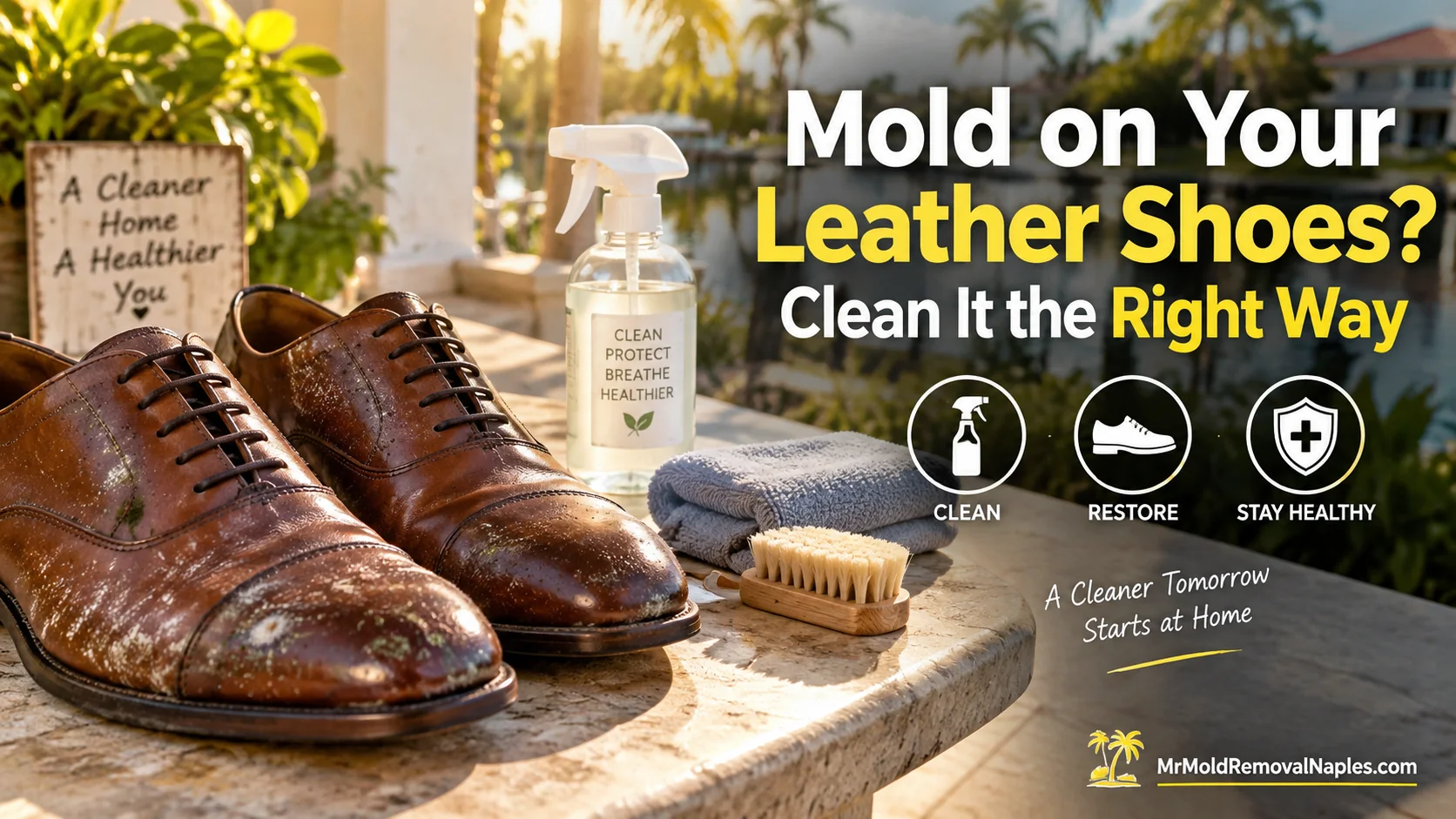
How to Clean Mold Off Leather Shoes (And When to Toss Them)
You reach into the back of your closet in late September and pull out the leather loafers you wore twice last spring. A faint gray fuzz is dusted across the toe, and there is a musty smell you cannot place. You are not alone. In humid Naples, leather shoes grow mold every single year, usually right after the rainy season or when a snowbird home sits closed for months.
The short answer: surface mold on smooth leather can often be cleaned at home, but mold that has soaked into the leather or the lining usually means the shoes are done. The honest part is that most people cannot tell the difference at a glance, and cleaning the wrong pair wastes hours and still leaves spores behind.
Honest answer: Mold on shoes is rarely just a shoe problem. If one pair in your closet is moldy, the humidity or a hidden moisture leak is the real issue, and it will keep ruining shoes, bags, and belts until it is fixed. Cleaning the shoes is step one. Finding out why they molded is the step that actually protects your home. This page is general information, not a replacement for professional advice.
Why Leather Shoes Mold So Fast in Naples
Leather is a natural material that breathes, which is exactly why it molds. It absorbs moisture from the air, and mold spores are everywhere in Florida, so the two only need one thing to meet: time in a damp, dark place.
Average humidity in Naples runs around 78 percent and peaks near 97 percent, according to the National Weather Service. A closet is darker and less ventilated than the rest of the house, which makes it a perfect growing spot. Shoes stored in plastic bins make it worse, because plastic traps the moisture the leather is already holding.
Add the Florida pattern of homes sitting closed during the hottest months and the hurricane season window from June to November, and you get the perfect recipe. Mold can spread within 72 hours of moisture being present, so a pair of damp shoes forgotten in a closet can be covered in visible growth within a week.
Step by Step: How to Clean Surface Mold Off Leather Shoes
Try this only when the mold is on the outside surface and the shoes are otherwise in good shape. Work outside or in a well-ventilated area, and wear gloves and a basic dust mask so you are not breathing in spores.
- Brush off the loose mold outside. Use a dry soft brush or an old toothbrush to knock off the visible fuzz. Do this away from the house so spores do not settle on your floors.
- Wipe with a gentle cleaning solution. Dampen a soft cloth with a mild soap and water mix or a diluted white vinegar solution. Wipe the surface, then go over it with a clean dry cloth. Never soak the leather, because more moisture feeds the problem.
- Dry the shoes completely. Let them air out in sunlight or near a fan for at least 24 to 48 hours. Direct sun also helps kill surface mold, but keep the leather out of extreme heat so it does not crack.
- Condition the leather. Once the shoes are fully dry, apply a leather conditioner to replace the oils the cleaning removed. Dry, cracked leather molds faster because it soaks up moisture.
Do not use bleach on leather. Bleach can damage the dye and the material, and it does not reach mold that has penetrated porous surfaces. If you want to understand why bleach fails on porous materials, our guide on whether bleach kills mold explains the difference between surface stains and real colonies.
| Situation | Best move | Why |
|---|---|---|
| Light fuzz on smooth leather, caught early | Clean with the steps above | Surface mold on sealed leather can often be removed |
| Mold on the inside lining or in the toe | Replace the shoes | You cannot fully clean the inside of most shoes |
| Musty smell stays after cleaning | Replace the shoes | The smell means mold is still growing inside the material |
| Expensive leather goods, mold is deep | Ask a professional leather cleaner | Specialists have tools and treatments homeowners do not |
| Mold keeps coming back on every pair | Fix the room, not the shoes | A hidden moisture problem will keep ruining belongings |
When Cleaning Is Not Enough
Here is the honest line most articles skip: if you can smell the mold, it is not a surface problem anymore. Leather is porous, and the musty smell means colonies are growing inside the material where a damp cloth cannot reach. The same goes for mold on the lining, the insole, or inside the toe box.
Cheap shoes are almost never worth saving. A $60 pair from the discount store is not worth the hours of cleaning and the risk of a lingering smell. Replace them and move on. High-end leather boots or a favorite pair of dress shoes may justify a professional leather cleaner, who can often treat items that would not survive a home cleaning.
If you are cleaning mold off shoes because they are in the same room as a bigger problem, pause and check the room first. Our guide to mold behind walls covers how mold hides inside wall cavities even when the visible signs are small.
The Real Fix: Find Out Why Your Closet Is Growing Mold
Here is the pattern we see in Naples homes again and again: a closet against an exterior wall, a bathroom on the other side, a slow leak from the roof or the AC line, and suddenly every leather thing in that closet is growing fuzz. The shoes are just the messenger.
Check for these moisture sources before you blame the shoes:
- AC condensation lines that drip into a wall or a closet corner
- Exterior wall closets where warm humid air meets a cooler surface
- Roof leaks that stain a ceiling or a closet top shelf
- Plumbing leaks inside a shared bathroom wall
- Closed-up homes with no AC running for months at a time
In Collier County, where average humidity sits near 78 percent, a professional mold inspection is the fastest way to find the source. Inspectors use moisture meters and thermal tools to trace the problem to its origin, and lab samples identify the mold type. A licensed inspection runs about $300 to $1,000 with an average near $600, and lab testing runs $75 to $100 per sample at a third-party accredited lab. If you are not sure what is happening behind your closet wall, a mold inspection in Naples gives you a clear answer instead of a guess.
How to Keep Mold Off Shoes in a Florida Closet
Once the moisture source is handled, prevention is straightforward. Mold needs three things: moisture, food, and time. Cut off the moisture and the food, and your shoes stay clean.
- Let shoes dry fully before storing them. Never put damp shoes away after a rainy day or a workout.
- Use breathable storage. Cloth shoe bags or open shelves beat plastic bins and sealed boxes.
- Add airflow. Leave closet doors open a few hours a day, or run a small fan on humid days.
- Run a dehumidifier in the bedroom or closet area during the wet months, when indoor humidity can climb toward the 97 percent peaks.
- Rotate shoes. Shoes that get worn and aired out regularly mold far less than shoes that sit untouched.
- Store off-season shoes with moisture absorbers like silica gel packs in breathable bags.
If you keep the closet dry and shoes still mold, suspect the wall behind them. Moisture inside a wall cavity can keep a closet humid even when the room feels fine, and that is exactly the situation where a mold removal and remediation team needs to open the wall, remove the moldy material, and dry the cavity to the IICRC S520 standard.
The Bottom Line on Moldy Leather Shoes
Clean light surface mold off smooth leather with a soft brush, a gentle solution, and a long dry time. Replace anything that smells, that has mold inside, or that keeps coming back. And remember that the shoes are rarely the real problem.
In a climate as humid as Naples, moldy shoes are usually the first visible sign of a moisture issue that will eventually reach your walls, your ceiling, or your HVAC system. Catching it early is cheaper every time. If you suspect a hidden leak or you just want to know for sure, an emergency mold response can stop the spread before it turns into a full remediation project, which typically runs $1,500 to $5,000 for most residential jobs in the Naples market. See our Naples mold remediation cost guide for the full range by project size.
Frequently Asked Questions
Yes, surface mold on smooth leather can often be cleaned at home with a soft brush, a gentle cleaning solution, and a dry cloth. The catch is that mold on leather is rarely only on the surface. Leather is porous, and if the mold has worked into the material or the inside lining, cleaning the outside will not fix the problem.
White vinegar is a common household cleaner that can help remove surface mold from smooth leather, but it is not a treatment for mold that has penetrated the material. Test any cleaner on a hidden spot first, because vinegar and other solutions can strip leather dye. If the mold comes back after cleaning, the shoes likely need to be replaced.
Naples air is humid most of the year, with average relative humidity around 78 percent and peaks near 97 percent. Leather absorbs moisture from the air, so shoes stored in a closet, a garage, or a closed-up snowbird home can grow mold even if they never got wet. Mold can spread within 72 hours once moisture is present.
Wearing moldy shoes puts mold spores right against your skin and close to your face, which can trigger sinus congestion, coughing, skin irritation, and asthma flare-ups. People with allergies, asthma, or weak immune systems should not wear moldy shoes at all. When in doubt, treat the shoes as a loss rather than risking your health.
Throw them away when the mold is on the inside lining, the leather feels soft or damaged, a musty smell stays after cleaning, or the mold keeps coming back. Cheap shoes are almost always not worth the effort. Expensive leather goods may be salvageable by a professional leather cleaner, but only if the mold is caught early on the surface.
Let shoes dry fully before storing them, keep closet doors open or run a small dehumidifier, add airflow with a fan, and store off-season shoes in breathable cloth bags instead of plastic. In Naples, the real fix is usually lowering the humidity in the room. If shoes keep molding despite those steps, the closet itself may have a hidden moisture problem.