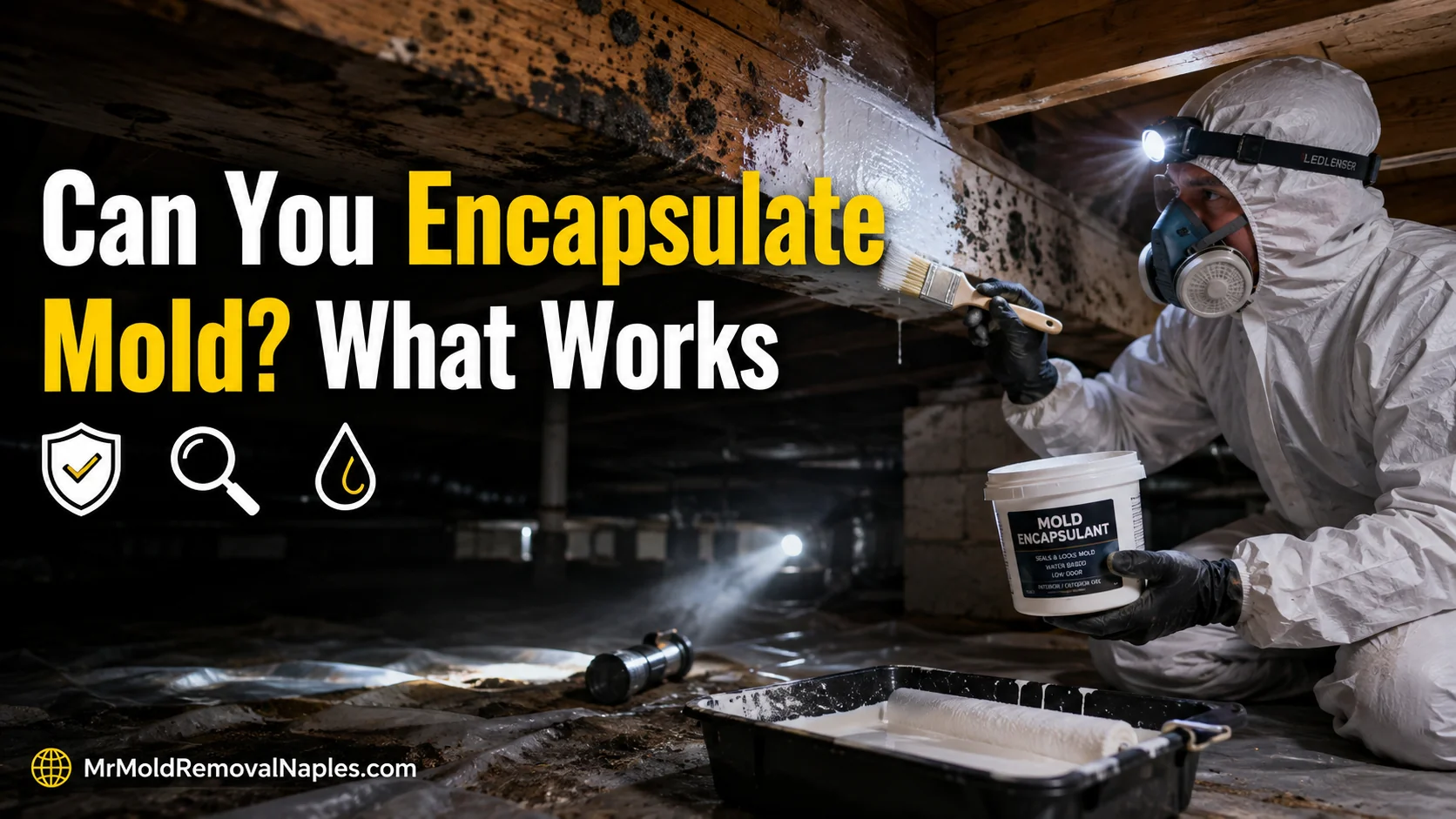
Can You Encapsulate Mold? Yes, But Only After the Source Is Fixed
You found dark mold on the wood under your Naples home, and the thought of cutting out a whole section of floor or drywall does not sound appealing. Before you reach for a brush and a bucket of sealant, here is what you need to know about mold encapsulation.
Yes, mold can be encapsulated, but only in specific situations. Encapsulation seals cleaned mold-affected surfaces under a thick coating so spores cannot become airborne. It works on non-porous surfaces after the moisture source is fixed. On porous materials like drywall, or when a leak is still active, encapsulation is not the answer.
Quick Verdict: Encapsulation locks mold in, but it does not kill it. Fix the moisture problem first, clean the affected area, and reserve encapsulation for non-porous surfaces. When in doubt, a professional assessment tells you whether the material can be saved or should be removed.
What Mold Encapsulation Actually Means
Mold encapsulation is the process of applying a thick, paint-like sealant over mold-affected surfaces. The coating bonds to the surface and locks down any spores and stains that remain after cleaning. Think of it as a heavy-duty barrier instead of a regular coat of paint.
Encapsulation is not the same as removal, and it is not the same as killing mold. It is a containment step. The mold stays where it is, sealed under the coating, which is why it only makes sense when the mold is on a surface that can support a reliable seal and when the moisture problem is solved.
When Encapsulation Works
Encapsulation can be a legitimate part of a remediation plan in a few specific situations. These are the cases where a contractor who follows the IICRC S520 standard might use an encapsulant:
- Non-porous surfaces. Sealed concrete, metal, tile, and smooth, intact wood can hold a coating well. Painted drywall in good condition can sometimes be sealed, but only after professional cleaning.
- After the source is fixed. The leak, condensation, or humidity problem has to be resolved first. In Naples, where average humidity runs around 78 percent and peaks near 97 percent according to the National Weather Service, an unfixed moisture problem will simply grow mold right through or around the coating.
- After professional cleaning. The area is cleaned and treated first to remove as much growth and contamination as possible. Encapsulation is the final layer, not the first step.
- Framing and structural wood. In crawlspaces and attics, cleaned structural wood is sometimes encapsulated as an extra barrier against future moisture, especially in humid coastal homes.
When Encapsulation Does Not Work
There are times when reaching for a sealant is the wrong move. Knowing these limits can save you from coating over a problem that will come back.
- Porous materials. Drywall, ceiling tile, carpet, insulation, and unpainted or water-soaked wood absorb mold deep into their structure. A surface coating cannot seal what is inside the material, so these are removed and replaced instead.
- Active moisture. Encapsulating over an active leak or ongoing condensation traps moisture behind the coating. Mold keeps growing and spreads to surrounding materials where you cannot see it.
- Heavy growth. Thick, established colonies should be removed, not sealed. Encapsulation over heavy growth can fail and release spores later.
- DIY paint jobs. Regular paint and primer are not encapsulation products. They do not have the thickness or bonding designed to lock down mold.
| Surface | Encapsulation possible? | Why |
|---|---|---|
| Sealed concrete | Yes | Non-porous, holds a thick coating well |
| Metal and tile | Yes | Smooth and non-porous after cleaning |
| Intact painted drywall | Conditional | Only after professional cleaning and source fix |
| Bare or soaked wood | Usually no | Mold penetrates the material |
| Drywall with mold inside | No | Must be cut out and replaced |
| Carpet, ceiling tile, insulation | No | Porous, removed and discarded |
Does Encapsulation Kill Mold?
No. This is the most common misunderstanding. Encapsulation physically seals mold, but it does not kill it. Encapsulants are not biocides, and no coating should be treated as a way to kill mold on its own.
That distinction matters because mold that stays alive under a coating can keep growing when moisture is present. In a humid climate like Collier County, where homes sit closed during snowbird season from May to October, trapped moisture is a real risk. If the coating fails or moisture finds a path in, the mold resumes growth where you cannot see it.
The Right Order: Fix, Clean, Then Encapsulate
If you are considering encapsulation, the sequence matters more than the product. Here is the order a professional remediation follows:
- Find and fix the moisture source. Whether it is a roof leak, a plumbing leak, or humidity, the source has to stop. Mold can spread within 72 hours of moisture intrusion, so speed matters.
- Assess the materials. A professional mold inspection documents what is growing and which materials are affected. Lab samples run $75 to $100 per sample at a third-party accredited lab.
- Remove what cannot be saved. Porous materials go out. Containment barriers, negative air pressure, and HEPA scrubbers rated at 99.97 percent efficiency at 0.3 microns keep spores from spreading during the work.
- Clean and treat the rest. Surviving surfaces are cleaned and treated before any coating goes on.
- Encapsulate only where appropriate. The encapsulant is applied in thick coats according to the label, usually in crawlspaces, attics, or on structural surfaces.
For the full process, see our mold removal and remediation page.
What Naples Homeowners Should Know About Crawlspace Encapsulation
When people search for encapsulating mold, many of them actually mean crawlspace encapsulation. A crawlspace encapsulation is different from coating mold: it is a complete moisture barrier system that covers the crawlspace floor and walls with heavy plastic sheeting, seals the vents, and often adds a dehumidifier.
That system is designed to prevent mold in the first place. It only makes sense after existing mold is handled and the space is dry. Encapsulating a damp crawlspace that already has mold, without cleaning first, seals the moisture in and makes the problem worse. If you have mold in your attic or crawlspace, our attic and crawlspace mold page covers the details.
How Much Encapsulation Costs in Naples
Encapsulation is usually part of a larger remediation project rather than a separate line item, so the cost depends on the overall job. Most residential mold projects in Naples run $1,500 to $5,000.
| Project | Verified Naples cost range |
|---|---|
| Small bathroom | $800 to $1,500 |
| Bedroom ceiling | $1,500 to $2,500 |
| Kitchen or drywall | $2,000 to $3,500 |
| Whole home or attic | $4,000 to $8,000+ |
| HVAC or duct work | $350 to $1,500 |
An inspection costs $300 to $1,000, with an average near $600, before any remediation begins. For a full breakdown, see our Naples mold remediation cost guide.
Florida homeowners insurance typically covers sudden, accidental water events, but long-term humidity and deferred maintenance usually are not covered. Policy caps commonly range from $1,000 to $10,000, and endorsements can raise that to $25,000 or $50,000. Check your policy before work begins.
The Bottom Line on Encapsulating Mold
Encapsulation is a real tool, but it is a narrow one. Fix the moisture, clean the surface, and encapsulate only the materials that can hold a seal. When mold is on porous materials or the source is still leaking, removal and replacement are the only honest answers.
If you are not sure which situation you are in, start with an inspection. A professional can tell you exactly what is growing, where the moisture is coming from, and which surfaces can be saved. That answer is worth far more than a bucket of sealant applied to the wrong problem.
Frequently Asked Questions
Yes, in limited cases. Encapsulation seals mold spores under a thick coating so they cannot release into the air. It works on non-porous surfaces like sealed concrete, metal, and smooth wood only after the mold has been cleaned and the moisture source has been fixed. It does not work on porous materials like drywall, and it never replaces fixing the leak or humidity problem that caused the mold.
Mold encapsulation means applying a thick, paint-like sealant over cleaned mold-affected surfaces. The coating locks in any remaining spores and stains so they cannot become airborne. It is one step in a full mold plan, not a shortcut. The area is cleaned first, then the encapsulant is applied in thick coats according to the product label.
No. Encapsulation does not kill mold, and it is not a biocide. It physically seals the mold under a coating. If moisture stays in the material or returns, mold can keep growing underneath and spread to surrounding surfaces. That is why the moisture source must be corrected before encapsulation, and why porous materials that cannot be saved are removed instead.
Regular paint is not mold encapsulation. A stain-blocking primer and paint can cover discoloration for a while, but mold can bleed back through when moisture is present. True encapsulation products are much thicker and are meant to lock down mold. Even with the right product, the surface still needs to be cleaned and the moisture problem fixed first.
Encapsulation is usually part of a larger remediation job, not a standalone line item. In Naples, most residential mold projects run $1,500 to $5,000 depending on the size of the area. A small bathroom runs $800 to $1,500, and whole-home or attic projects run $4,000 to $8,000 or more. An inspection first costs $300 to $1,000 with an average near $600, plus $75 to $100 per lab sample.
Never encapsulate mold on porous materials like drywall, ceiling tile, carpet, or unpainted wood that is soaked through. Those materials hold mold inside and cannot be sealed reliably. Never encapsulate over an active leak or ongoing humidity problem, because mold will grow back. Never coat over heavy growth without cleaning first. In those situations, the contaminated material is removed and replaced.