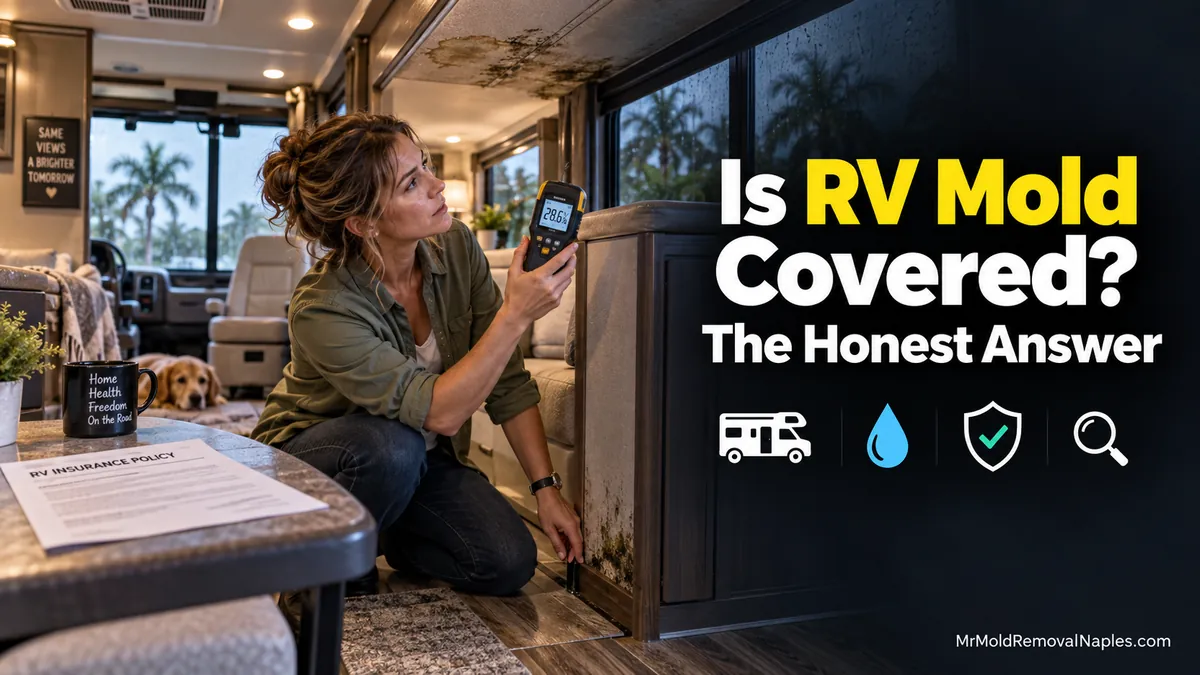
Is Mold Damage Covered by Full-Time RV Insurance? What Naples Full-Timers Should Know
It is the first week of October, you have been living in your motorhome at a park off Tamiami Trail all summer, and you finally open the cabinet under the dinette. The floor has gone soft. There is a brown ring on the ceiling panel the size of a dinner plate. The whole coach smells like a wet basement, and your first call is to your insurance agent, who answers with a question instead of an answer: was this sudden, or has water been getting in for a while? That one question decides almost every mold claim on an RV.
The short answer: full-time RV insurance usually does not cover mold damage by itself. Insurers treat mold as the result of a long-term moisture problem, and long-term is excluded on nearly every policy. There is a real exception, and it matters. If mold grew because of a sudden, accidental water event your policy already covers, such as a burst supply line, a failed water heater, or storm damage that opened the roof, then the cleanup is far more likely to be paid. Coverage follows the cause, not the mold.
Honest answer: This is general information, not legal or insurance advice, and it cannot replace your own policy language. Every full-timer policy reads differently, and the only authoritative answer for your coach lives in your declarations page and your exclusions section. When real money is on the line, ask your adjuster in writing and keep the reply. If you are dealing with growth inside a home in Collier County rather than a rig, the same logic applies, and a local mold inspection in Naples is the fastest way to find out how far it has spread.
What Full-Time RV Insurance Actually Covers
Full-timer coverage is not the same product as a standard RV policy, and that difference is the first thing to understand. A standard auto or RV policy covers the vehicle. A full-timer policy adds something closer to homeowners coverage because the RV is your residence: personal liability, contents, loss of use, and property coverage on the coach itself.
Most full-timer policies are written on what insurers call a special form, which means everything is covered unless it is specifically excluded. That sounds generous until you reach the exclusions, where you will normally find mold, mildew, fungus, rot, and bacteria sitting next to the causes insurers group together: constant or repeated seepage, gradual leakage, wear and tear, and neglected maintenance.
There is one more layer worth knowing before you assume the worst. Many policies include a small sublimit for mold cleanup, and that cap is usually far smaller than a real remediation bill. A sublimit is a ceiling inside the policy, not a promise. If the work runs past the cap, the rest is yours. On some policies the mold exclusion is softened so that growth caused directly by a covered peril gets paid up to that cap, while on others mold is excluded flatly with no sublimit at all. You cannot assume which one you bought. You have to read it.
Why Insurers Split Water Damage Into Two Buckets
Insurance runs on the difference between a sudden event and a slow one. A sudden, accidental discharge of water is insurable. Water that has been getting in for months is treated as maintenance, and maintenance is never insurable. That is not the industry being difficult for no reason. It is the definition of what a policy is for: one-time accidents, not deferred upkeep.
Mold lands on the wrong side of that line almost every time, because mold needs time. Spores need a wet surface for roughly 72 hours before growth takes hold, and visible colonies usually mean water has been present for weeks. When an adjuster sees a stained ceiling panel and a soft subfloor, the first question is how long that moisture has been there, and the honest answer is almost always longer than the owner realized.
| Situation | Likely outcome | Why |
|---|---|---|
| Burst water line, mold found within days | More likely covered | A sudden accidental discharge is a covered peril, and the cleanup ties back to the event |
| Roof or slide damaged in a storm, water entered, mold followed | Often covered, sometimes up to a mold sublimit | The storm damage is covered, so the mold is treated as a consequence |
| Water heater or fitting failed and leaked into the floor | Depends on age and service history | Sudden failure can be covered, while rust and corrosion point to wear |
| Roof seams, slide seals, or window seals leaking for a season | Usually denied | Repeated seepage and gradual leakage are excluded on purpose |
| Condensation from humidity inside a closed coach | Usually denied | No single event, so there is no covered peril to tie it to |
| Slow leak finally discovered at resale | Usually denied | Clearly gradual, clearly long term |
The Naples Problem: Humidity, Storms, and Stored Coaches
If you full-time in Collier County, you are running your coach through one of the hardest moisture environments in the country. Naples averages roughly 78 percent relative humidity, and the National Weather Service records peaks near 97 percent during the wet season. That is a permanent film of moisture on every cool surface inside a rig, all summer long.
Then add hurricane season, which runs June through November. Ian in 2022 and Helene and Milton in 2024 all pushed water into Southwest Florida homes and vehicles, and a coach that takes on water in a storm is a coach with a mold clock running. Even a small roof or slide seal breach lets in enough water to start growth behind the paneling, where you will not see it for weeks.
The third factor is how coaches are actually used here. A rig that sits closed with the AC off through a Florida summer is a greenhouse. Warm, humid, dark, and still is exactly what mold wants. Full-timers who head north for a month and shut the coach down without dehumidification come back to a problem more often than they expect. If you want the mechanics of how that shows up, our guide to finding mold behind walls explains where growth hides and how to check for it without tearing anything open.
Where RV Mold Usually Starts
An RV has more ways for water to get in than a house, because the envelope moves and seals age. These are the entry points we see most often, roughly in order:
- Roof seams and vent flanges: lap sealant dries and cracks under the Florida sun, and water tracks along the ceiling.
- Slide-out seals and slide roofs: the number one entry point on a coach that is lived in full time.
- Window and storage compartment seals: small gaps that soak the wall framing underneath.
- Plumbing and water heater fittings: slow drips under the sink, behind the shower, and at the heater.
- Shower pans and toilet flanges: water escapes at the seams instead of going down the drain.
- AC condensate drains: a clogged line puts water on the roof or the floor instead of outside.
- Closed-up humidity: condensation forming on cold surfaces during a summer shutdown.
What to Do the Moment You Find Mold
What you do in the first 24 hours matters more than anything an adjuster decides later, for two reasons. Almost every policy requires you to mitigate further damage, and mold does not wait for a claim number.
- Document before you touch it. Photos and video of every stained panel, soft floor, and wet corner, plus the roof and seals from outside. Timestamps matter. You cannot photograph a ceiling stain after it has been cut out.
- Stop the water. Patch the leak, cap the line, or seal the seam. Stopping the source is the first duty your mitigation clause will be measured against.
- Dry it out hard. Open vents, cabinets, and slides. Run a dehumidifier and fans. Mold needs moisture, and every hour you take moisture out of the coach is an hour the colony loses.
- Call your adjuster the same day and put it in writing. Report the water event, not just the mold, and say when you found it and what caused it.
- Do not start cutting or spraying without a plan. Ripping out paneling destroys the evidence your claim depends on, and bleach on porous materials is wasted effort that does not fix the growth.
Keep every receipt. Many policies reimburse drying and mitigation costs even when the mold itself is excluded, and that can be a meaningful amount of money. If the adjuster denies the mold but pays to dry the coach, you are still far ahead of doing nothing.
If the Mold Is in a Home Instead of the Rig
Plenty of Naples full-timers keep a base in the area: a park model, a manufactured home, or a family house. The insurance logic is different there, but the exclusions rhyme. Florida homeowners policies typically pay for sudden and accidental water events, and typically do not pay for long-term humidity, deferred maintenance, or the mold that grows out of either one. Mold caps on those policies commonly run $1,000 to $10,000, and endorsements can raise the limit to $25,000 or $50,000.
What does not change is that the work has to be done, and done properly. Professional remediation follows the IICRC S520 standard, which means containment barriers, negative air pressure, HEPA filtration rated to 99.97 percent at 0.3 microns, removal of porous materials that cannot be cleaned, and clearance testing at the end. Wiping a surface down does not remediate a wall cavity, and that difference is why the job carries a real cost.
In this market, a mold inspection runs about $300 to $1,000 with lab samples at $75 to $100 each, and most residential remediation projects land between $1,500 and $5,000. For the full breakdown by room and size, see our Naples mold remediation cost guide. If water came in during a storm and the clock is running, an emergency mold response in the first 24 hours is what keeps a small loss small, and our mold removal and remediation page walks through what the full process looks like from containment to clearance. When the growth is inside the HVAC system or ductwork, that is its own scope of work, which we cover on the HVAC and air duct mold page.
The Bottom Line for Full-Timers
Assume mold is not covered, then go read your policy to find out whether that assumption is wrong. If you carry full-timer coverage, look for the water damage and fungus exclusions, look for any mold sublimit, and look for the mitigation duty. Then do the two things that actually protect you in Florida: keep water out of the coach before it becomes a colony, and document the moment it gets in.
The honest economics are simple. One season of Florida humidity in a neglected coach can cost more than a decade of seal maintenance. Check the roof, the slide seals, and the water heater twice a year, run a dehumidifier whenever the coach sits, and you will stay on the right side of the line between an accident and maintenance. That line is the whole claim.
Frequently Asked Questions
Usually not by itself. Full-timer policies typically exclude mold, mildew, fungus, and rot, and they also exclude the gradual seepage and deferred maintenance that let mold grow. The exception is mold caused directly by a covered sudden event, such as a burst water line or storm damage that opened the roof. Even then, the cleanup is often capped by a small mold sublimit, and some policies have no mold coverage at all.
A standard RV or auto policy is built to cover the vehicle, not the living space, and it does not provide homeowners-style property coverage. It also excludes mold and gradual water damage. If you live in the RV full time, you need a full-timer policy that adds liability, contents, and loss of use, and even that policy will treat mold as excluded or sublimited.
That is the strongest version of an RV mold claim you can have. Storm damage to the roof or a slide is a covered peril, and if water came in through that damage and mold followed, the cleanup ties back to the covered event. Report it fast, document the storm damage and the water path with photos, and be ready for the insurer to apply a mold sublimit rather than paying the full remediation.
Often yes. Drying and mitigation are usually treated separately from mold remediation, and many policies reimburse reasonable costs to stop further damage even when the mold exclusion applies. Keep every receipt for fans, dehumidifiers, and any emergency drying help, and submit them with the claim. Mitigation is also a duty under most policies, so doing it protects the claim you do have.
Mold can begin growing in roughly 72 hours once a surface stays wet, and in a Naples summer that clock runs faster because the air is already loaded with humidity. In a closed coach, moisture from a slow roof or slide leak spreads into paneling and insulation where you cannot see it, so real growth is often weeks old by the time a stain or smell shows up.
On hard, non-porous surfaces you can often clean surface growth with a proper detergent solution and thorough drying. Porous materials are a different story: paneling, carpet, upholstery, and insulation hold roots and spores that cleaning cannot remove, so they usually have to be cut out and replaced. Never spray bleach into the vents or ductwork, and never dry-scrub a moldy surface, because that puts spores into the air.
Water damage claims can affect what you pay at renewal, and a history of repeated water losses can make a coach harder to insure. Before you file, ask your agent how the claim would be recorded and what it would do to the policy. A claim that is denied for a gradual leak can still leave a record, so it is worth asking the question first.