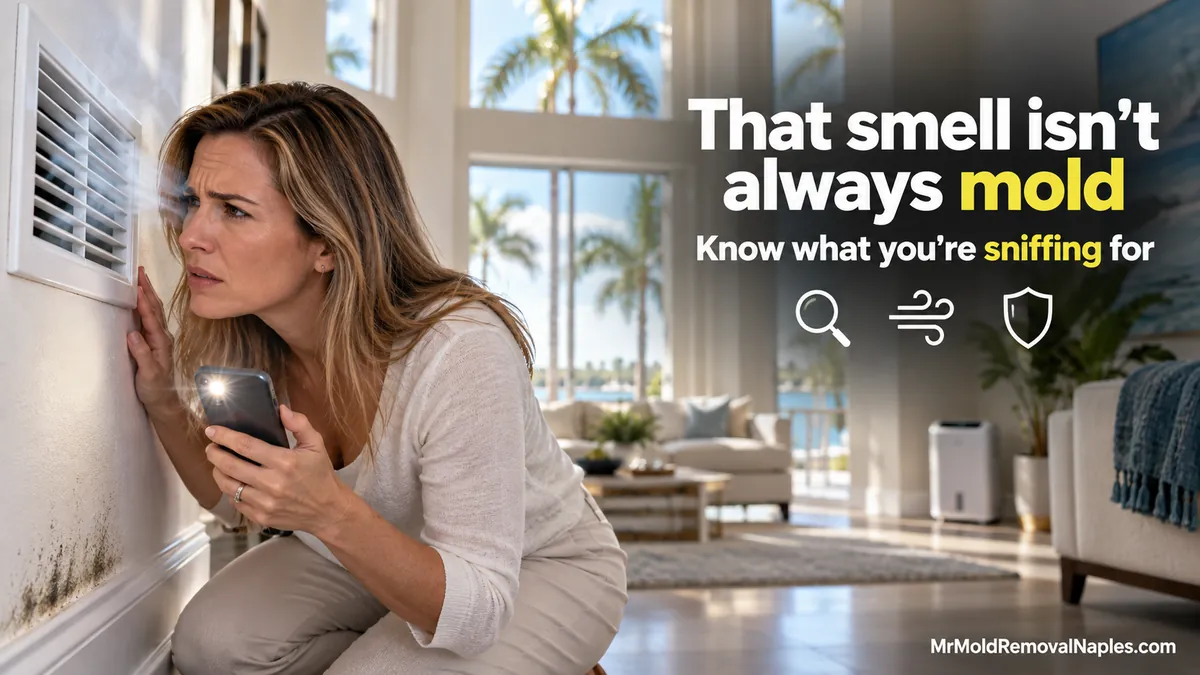
Can Mold Smell Like Weed? What That Smell in Your Naples Home Really Is
It is late September and you just opened the guest bedroom for the first time since spring. The air hits you with something grassy, skunky, almost sweet, and your first thought is not mold. Your second thought is the question you typed into a search bar: can mold smell like weed? You are not imagining it, and you are not the first Naples homeowner to ask.
The short answer: mold usually does not smell like marijuana. Mold smells musty and earthy, like a damp basement, wet cardboard, or old socks. A strong weed-like smell in a home is far more often real cannabis smoke from a neighbor or a previous occupant. But the honest part is that the two situations can feel identical from the nose alone, especially in a humid house, and in some cases moldy growth does give off a sharp, pungent, skunky odor that people describe as weed-like.
Honest answer: Your nose is a poor mold detector. Mold gives off chemical compounds that produce a range of smells, and different people describe the same odor differently. The reliable move is not to argue with the smell, it is to find the source. A musty smell that will not go away usually means moisture and microbial growth somewhere in the home, and in Naples, that is worth taking seriously. This page is general information, not a replacement for professional advice.
What Mold Actually Smells Like
When mold grows, it releases microbial volatile organic compounds, often shortened to mVOCs. These are the chemicals that create the classic mold smell: musty, earthy, stale, like wet dirt or damp wood. If you have ever opened a closed-up closet after a humid week, you know the smell instantly. It is the odor of decay, and it is your first warning that something is growing.
Different molds can smell slightly different. Some give off a sweet, rotting smell, some smell sour, and a few produce odors people describe as pungent or skunky. But the vast majority of mold in Florida homes smells musty and damp, not like weed. If the smell in your home is clearly musty, treat it as a moisture problem and start looking for the source rather than guessing the species from the odor.
One more thing to understand: mold does not need to be visible to smell. Growth inside a wall cavity, under a sink cabinet, or in an air handler can produce a strong odor while the only visible clue is nothing at all. In Collier County, where average humidity runs near 78 percent and can peak near 97 percent, hidden mold is common, especially after the rainy season.
Why People Confuse Mold Smells With Weed
There are four honest reasons a Naples homeowner might search the exact question you searched. The first is the most common: the smell is real cannabis smoke, not mold. Naples has plenty of neighbors, renters, and guests, and smoke travels through shared walls, AC vents, and open windows. If the smell comes and goes, shows up in the evening, or is strongest near a shared wall, it is probably smoke.
The second reason is a skunk outside. Skunk spray has a sharp, sweet, skunky odor that carries a long way, and a single spray near a window can make a whole room smell like something burned. The third reason is sewer gas. A dry drain or a failing wax seal can push a pungent, sulfur-like smell into a bathroom that some people describe in colorful terms. The fourth reason is actual mold, but mold that smells grassy or sour rather than classically musty, which happens more often with heavy growth on wood or paper-faced drywall.
There is also a fifth, quieter reason that deserves honesty: a home that sat closed and humid for months can have both problems at once. A snowbird home in Naples that was shut down in May and reopened in September can smell musty from mold while the neighbor's patio smoke drifts through the same open door, and the nose blends it into one confusing odor.
| Symptom | More likely | Why |
|---|---|---|
| Musty, earthy, damp, like wet cardboard | Mold or mildew | Classic mVOC odor from microbial growth |
| Skunky and sweet, comes and goes, strongest at night | Cannabis smoke | Smoke travels through walls, vents, and windows |
| Sharp, sulfur-like, near a sink or drain | Sewer gas | Dry P-trap or failing seal under the fixture |
| Sweet, rotten, or sickly smell that lingers | Dead animal or heavy decay | Decomposition odor in a wall, attic, or crawl space |
| Grassy, sour, or pungent, tied to one damp spot | Heavy mold on wood or drywall | Dense colonies produce stronger, stranger odors |
How to Tell Mold From Real Marijuana Smoke
You do not need to be a smell expert to sort this out. You need to watch three things: timing, location, and moisture.
Timing: smoke is intermittent, mold is constant. If the smell appears at certain hours, disappears when windows close, or vanishes for days at a time, it is almost certainly coming from outside or from a neighbor. A mold smell does not take nights off. It is there in the morning, there at noon, and there when the AC kicks on.
Location: smoke follows airflow, mold follows moisture. Cannabis smoke shows up near shared walls, bathroom exhaust vents, and windows, wherever air moves between units or from outside. Mold smell is anchored to one area: a closet corner, a bathroom vanity, a bedroom ceiling, an AC supply vent. If you can walk toward the smell and it gets stronger in one specific spot, think moisture, not smoke.
Moisture: check for the things mold needs. Mold needs moisture, a food source, and time. In Naples that means checking for roof leaks after a storm, condensation on AC lines, damp drywall near a shower, and standing water in a drip pan. Mold can begin spreading within 72 hours of moisture being present, so a slow leak found late is often a mold problem found late.
If the smell is clearly musty and you can point to a damp area, start with our guide to finding mold behind walls, because that is where the worst smells hide in this climate.
The Naples Factor: Why This Happens Here
Naples is not an average market for smell complaints, and you should know why. Collier County has a humid subtropical climate with average relative humidity around 78 percent, and the National Weather Service records peaks near 97 percent during the wet season. Add hurricane season from June to November, and every home in the area takes a regular moisture beating.
The other piece is how Naples homes are used. Thousands of Collier County homes sit closed for months while owners are up north, with the AC off or set high to save power. That is exactly the environment where mold grows: warm, humid, and undisturbed. When owners return and open the door, the first thing they meet is the smell, and the smell does not always read as mold on the first breath.
If your home was closed up for the summer, the musty smell is your signal to check the areas that stayed damp: the AC closet, the laundry room, under both sinks, and the attic access. If you find visible growth, do not clean it dry. Porous materials like drywall and insulation that are moldy need to be removed, not wiped, and the work should follow the IICRC S520 standard with containment and HEPA filtration.
When the Smell Keeps Coming Back
Here is the pattern we see in Naples again and again: the homeowner smells something odd, decides it is probably the neighbor or a one-time thing, runs the AC, and forgets about it. Then the smell returns after the next rain, then after the next humid stretch, and eventually they notice a dark spot on the ceiling or a soft patch of drywall. By the time mold is visible, it has usually been growing for weeks.
That is why the honest advice is to investigate the first time you smell it, not the fifth. Start with the cheap checks: look under sinks, open the AC filter compartment, feel the drywall near exterior walls for softness, and check the attic for daylight or staining. If those checks turn up nothing but the smell persists, the source is likely hidden, and hidden sources are exactly what a professional inspection is built to find.
Inspection costs in the Naples market run about $300 to $1,000 with an average near $600, and lab testing of samples runs $75 to $100 per sample at a third-party accredited lab. A certified inspector uses moisture meters, thermal imaging, and air sampling to trace a smell to its origin instead of guessing. If you cannot find the source of a persistent smell, a mold inspection in Naples is the fastest way to get a straight answer.
What to Do If the Smell Is Coming From Your AC
In many Naples homes the smell is strongest at the vents, which points to the AC system. Condensate lines, drip pans, and blower compartments stay damp for months at a time, and mold inside the system blows a steady stream of odor into every room whenever the AC runs. That is why the smell seems to be everywhere at once, and why it never quite goes away.
If the odor is strongest when the air handler kicks on, check the filter first and replace it if it is damp or discolored. Look at the condensate drain line where it exits the house and make sure water is actually flowing. Do not spray bleach into the system or the ducts, because bleach does not fix mold on porous surfaces and the residue is not something you want blown through the home. Duct and HVAC mold cleanup in the Naples area typically runs $350 to $1,500 depending on the system size and how far the growth has spread.
If the smell is tied to your vents and you want a full picture of what can grow inside a system, our guide to HVAC and air duct mold walks through where it hides and how professionals remove it.
Your Health Is the Real Question
At some point every homeowner with a strange smell asks whether it is worth worrying about. Here is the honest answer for mold: mold exposure can trigger sinus congestion, chronic coughing, headaches, fatigue, brain fog, and asthma flare-ups, and people with allergies or weak immune systems feel it fastest. You do not need to be able to name the smell to know that a home should not smell like decay.
If anyone in the home has been congested, coughing, or unusually tired since the smell appeared, treat that as a signal too. Do not wait for a visible patch of mold to take the smell seriously. By the time growth is visible, the spores have been in the air for weeks. Our guide to mold exposure symptoms explains which symptoms are worth watching and when to see a doctor.
And if the situation is moving fast, whether it is a roof leak from a storm or a burst line, do not let it sit. Most residential mold remediation in the Naples market runs $1,500 to $5,000, and catching a problem early keeps the job small. An emergency mold response can stabilize a wet home in the first 24 hours, which is when it matters most. For a full breakdown of what projects cost at each size, see the Naples mold remediation cost guide.
Frequently Asked Questions
Usually no. Mold most often smells musty and earthy, like a damp basement or wet cardboard. That said, dense mold growth on wood or drywall can give off sharp, grassy, or skunky odors that some people compare to weed. If the smell comes and goes or appears at certain times of day, real cannabis smoke from a neighbor is more likely than mold.
The classic mold smell is musty, stale, and damp, often described as wet cardboard, old socks, damp wood, or a closed-up basement. Mold releases microbial volatile organic compounds as it grows, and those chemicals produce the odor. The smell can be present even when no mold is visible because growth often happens inside walls, under cabinets, or in an AC system.
The most common causes are a neighbor smoking nearby, smoke drifting through shared walls or vents, a skunk outside, sewer gas from a dry drain, or mold growth that produces a pungent odor. Watch the timing and location. If the smell appears at certain hours or is strongest near a shared wall, it is likely smoke. If it is constant and strongest near one damp area, check for mold or sewer gas.
Yes. Different molds and the bacteria that grow alongside them produce different odors. Some growth smells sour, some smells sweet and rotting, and heavy colonies on wood can smell pungent or skunky. A sweet, sickly smell in a wall or attic can also mean a dead animal, so it is worth finding the source before assuming mold.
In a humid climate like Naples, a persistent musty smell is mold or mildew until proven otherwise. Mold needs moisture, a food source, and time, and all three are easy to find in Collier County homes. If the smell will not go away after cleaning and airing out the room, have the area inspected, because hidden mold can smell strongly while staying completely out of sight.
Start by narrowing the location: walk toward the smell until it peaks, then check that area for moisture, soft drywall, stains, or visible growth. Check under sinks, around the AC, and in the attic. If you cannot find the source, hire a certified mold inspector. Inspections in Naples typically run $300 to $1,000 with lab samples at $75 to $100 each, and the inspector's tools can trace the odor to a hidden source.
Mold exposure can trigger sinus congestion, chronic coughing, headaches, fatigue, brain fog, skin irritation, and asthma flare-ups. The smell itself is a warning that spores and microbial compounds are in the air. People with allergies, asthma, or weakened immune systems tend to react fastest, and children and older adults are also more sensitive.